

Karen Merlin lives in Les Contamines. When UTMB comes through the valley later this week, it goes right through her town.
I wanted to talk to her ahead of race week because this spring she moved into a job that didn’t exist before she took it, and the title itself is a curious one. Elite athlete relations and inclusion programs sound like two different departments until you realize that the pros are the visible surface of the sport, and who wins, who gets covered, and who ends up in the photography all feed the same representation question about who thinks this sport is for them, a topic I’ve talked about quite a few times here before and on the pod.
Listen to the episode
🎧 Listen on Spotify · Listen on Apple Podcasts · Watch on YouTube
Guest snapshot
Who: Karen Merlin, Elite Athletes and Inclusion Programs Manager, UTMB Group Where: Les Contamines, France Day job: Elite athlete relations and inclusion programs across UTMB World Series
Who is Karen?
She grew up outside Seattle, came to France for a ski season 20 years ago, and stayed for the place and her eventual husband. She has been at UTMB about five years, the first four in marketing and communications (she helped coordinate my conversation with Michel and Catherine Poletti; the founders of UTMB!). She has two kids, and still takes photos of the Alps like a tourist.

We recorded on the Thursday before race week. It airs the Tuesday of UTMB week, and by the time most of you read this I will be in Chamonix.
Here is what stuck with me.
The scale question
I asked how UTMB thinks about growing without repeating whatever skate and ski got wrong during their boom years. The first answer was the one you would expect, about constant conversation and respecting the heritage of Mont-Blanc. So I asked the smaller version: what does too far and too fast actually look like?
Her answer was that UTMB runs 65 events, and there are more than 22,000 trail races in the world. They have a lot of visibility, but they are one piece of the ecosystem alongside local races, run clubs, and shops.
Her version of restraint is adding a handful of events a year instead of trying to be everywhere (even if it seems like that’s what’s happening), and going where a community is already asking for a race. Whether that holds as the calendar grows is a good thing to keep watching. But the number is a useful re-adjustment if you spend a lot of time online and/or reading the comments, where UTMB can feel like the entire sport.
How things actually change inside UTMB
This happens via organized athlete bodies. The PTRA on anti-doping, a women’s working group, separate groups on sport and environmental questions.
Karen was clear that this is not UTMB announcing decisions and athletes reacting to them. Her stance was that both sides have to be open to exchange and compromise, and she described the earlier years as having road bumps, which is a generous way to put it given how openly, uh, challenging that relationship was not long ago.
Paths to Parenthood came out of the women’s working group inside the PTRA. So did a chunk of the feedback on the UTMB Index revision, where athletes pushed back on how scores lined up against how the courses actually ran. What’s important to know is that individual complaints did not move the organization much, and a structured counterparty did.
The 20K problem
I have been going through RIDC data on why people who are trail-curious never actually go, and the finding that stuck with me is that cost is not the blocker. RIDC data below. The blockers are informational. What shoes do I need? What do I carry? What do I do if I see an animal? How do I even find a trail?
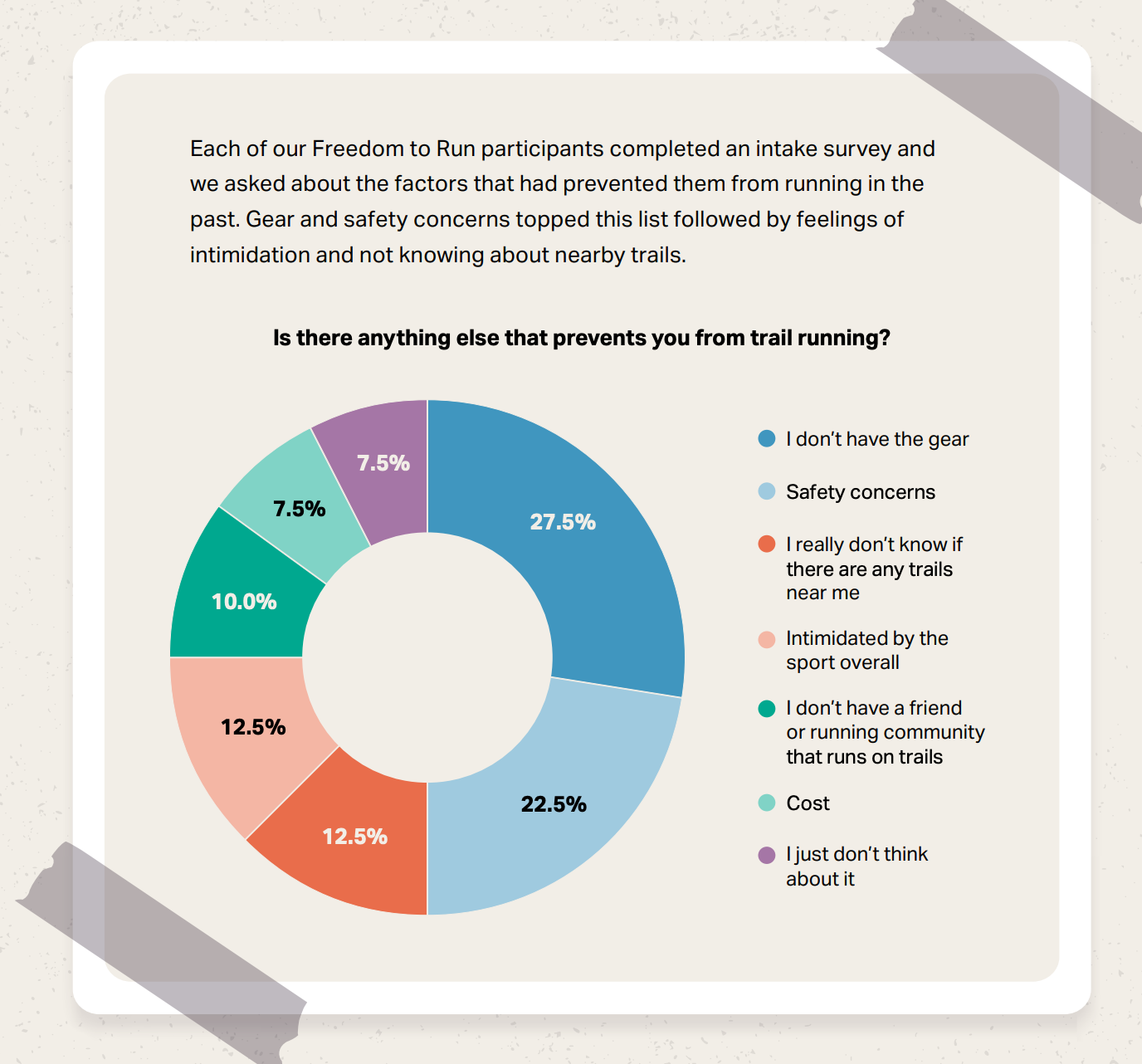
Report linked here.
I brought that topic up to Karen with the brand folks who listen to this show in mind, because if the barrier is education rather than price, a lot of money and effort going toward discount codes and sales is pointed at the wrong problem. I saw my own version of this in campaign data this year with the podcast network. On a campaign I ran with a half dozen shows, the two smallest shows (both hosted by dietitians) beat much larger general running shows on cost per acquisition by a very wide margin. Not because of larger audiences, but because the hosts are teaching people how to fuel for distance running, not just sharing coupon codes.
Her answer had two parts. The first is content, and UTMB has new material in production aimed specifically at first-time runners.
The second is the one I had not thought about. UTMB races are generally 20K, 50K, 100K, and 100 miles. For somebody who has never run on dirt, 20K is not an entry point, it is a goal race; that can be 3-4+ hours or more. So part of her work is pushing events in the series to add shorter distances, the dip-your-toe version, and then building a path that lets a runner move up without each step feeling like a whole different sport.
Road running has the 5K at the bottom of every ladder and you can find them nearly every weekend in most cities. Trail histoically starts at a distance that requires you to already be a runner.
The hotline
This is news, and I have not seen it mentioned yet. UTMB is adding a hotline this year so that runners who experience unwanted behavior or an uncomfortable situation on course have a way to report it and reach someone who can act on it.
It sits alongside the rest of what they have built into the courses: kits for women stocked at aid stations, dedicated changing spaces, dedicated toilets. Perhaps it removes a reason somebody might decide not to start. If you work at a brand that talks about accessibility, this list is a decent benchmark for what the work looks like once it stops being a campaign and becomes a line item.
The index freeze
I asked what we got wrong ten years ago about women’s careers, given how many of the biggest names right now are in their thirties and forties. Karen went to the professionalization of the sport and sponsor support, and then to a detail inside the parenthood policy that deserves some extra attention.
Athletes can freeze their UTMB Index.
The Index gates race entry. It gets used in sponsorship conversations. It shapes who gets coverage and who doesn’t. Freezing it means an athlete stepping away for pregnancy, IVF, adoption, or other reasons will not come back to a decreased score, a lost start line, and a weaker position in terms of sponsor negotiations. That is a policy about leverage, and it is the piece I would study if you are involved in athlete contracts.
Forty two and forty two
This was a fun one. UTMB audits its own content coverage internally, and Karen said it runs around 42% covering women, 42% covering men, with the rest landscapes and other visuals.
I would love to see other organizations publish the same figure. Right now UTMB may be the only one that can.
I spent this past weekend covering the Leadville Trail 100 Run on behalf of Life Time, and it was impressive how intentional they were with providing equal coverage. Check it out at https://www.instagram.com/leadvilleraceseries. That team walks the walk; trust me.
Why the field got so deep
Visibility compounds. I wrote about this after Western States, around The Trail Running Flywheel. Broadcasts let you follow a runner’s story in real time, the story pulls people in, the fields deepen, and the racing gets better. She pointed out that you used to see one or two women with a runaway lead, and now there are enough lead changes and enough contenders that the outcome is wide open, like we saw at Leadville this past weekend.
She also pointed to Rachel Entrekin at Cocodona, and specifically to Entrekin saying “why not me?” Karen’s argument was that the phrasing did the work, because other women (and men) heard it and recalibrated what they were allowed to attempt.
We got into something I have believed for most of my 15 years around ambassador programs, which is that women tend to tell the whole story of being an athlete rather than only the performance layer, and that is a large part of why the partnership math keeps working out the way it does. Karen made the point that the inspiration is not gender-specific, and she is right. I am as invested in Rachel’s story as anyone she was speaking to.
Rachel and I spoke on FTLR earlier this year; it was awesome.
What brands still get wrong
Salomon signing Grayson Murphy mid-pregnancy is the example I come back to (and will keep referencing). I spent a weekend with Grayson at Big Alta with Salomon, and watching a world champ shuffle up a hill and have to walk was the most relatable thing I saw all year from a pro athlete.
Karen’s version of this is that there have been a lot of pregnancy announcements lately, and what is new is that brands are putting a spotlight on them instead of letting those athletes disappear for a season. People are at their most relatable when they are building a family, or hurt, or not able to run. Brands that only show up for the wins are not just leaving the most useful material on the table, but they’re not truly supporting the whole human.
What is still open
Prize money has been split evenly between men and women since 2018, so I asked what gaps remain. Anti-doping came first, then making people feel welcome on course, then a broader idea about protecting athletes across the World Series.
What Karen asks of media this week
I asked her to put the PR hat back on and tell us how not to be a problem in the valley. Park where you are supposed to park. Speak kindly to people even when you badly want the shot. Protect the natural spaces.
Then she said that you can always find things to complain about, and that this week is a privilege worth enjoying. Her instruction was to soak it up, say wow, and look out for each other out there.
I’ll definitely be saying wow a lot!
Her race week picks
From someone who lives on the course:
The PTL start, Monday morning. They head out for 300 kilometers with their spirits high.
The Monday panel on championing space for women in trail, at the fan experience.
The Elites presentation, Wednesday. Max hype.
ETC over in Courmayeur, where she says the ambiance is unmatched.
The women’s watch party, Saturday, in the fan experience, right where runners come through.
The finish line at five or six in the morning. Quiet, and her favorite moment of the week. As she put it, they come back changed.
Come find me: Tech in Running, Wednesday at 2 p.m.
I am hosting a panel for TrainingPeaks during race week.
📍 L’Hydromel, two blocks from the finish line, Chamonix 🗓️ Wednesday, August 26, 2 p.m.
Host: Me!
Panelists:
Allison Lynch, Amazfit
Arnar Larusson, Tymewear
Doug Stewart, Elite Trail Team
Corrine Malcolm, Hoka and Trail Society Podcast
We are getting into where the data helps, where it is noise, where it falls short for women, and what the next few years look like for athletes and the brands building for them. Come say hello, especially if we have only ever talked online. It is my first time in Chamonix and I am here!! (actually, I’m still in the airport in Geneva. I’m coming soon!!)
I’m also co-hosting an industry conversation night with Matt Trappe, similar to what he did with Aaron Lutze at TrailCon.
A word from our sponsors
Halo. The hospitality platform built by runners for the way people actually travel to races. Branded home bases for brands, better rates and real community for event organizers, and a lot less hassle for everyone else. Reach out to their team and tell them you heard about Halo on Long Run Labs, or get in touch with me and I’ll make the intro. Hear more from their CEO/Founder in our episode. I’m thinking about staying at their clubhouse in New York for the marathon with rabbit. Let me know if you’re going!
Popfly. The creator program platform built for outdoor, travel, and adventure brands. It connects you with the largest community of adventure creators on the planet: people who actually use the gear, live the lifestyle, and have built real trust with their audiences. Affiliate links, discount codes, creator and ambassador collabs, all in one place. If you’re a brand, learn more here. If you’re a creator, sign up here.
Takeaways
The hotline is a headline. UTMB is adding an on-course reporting channel for unwanted behavior this year.
The index freeze is the smartest part of the parenthood policy. It protects race access and sponsorship leverage, not just goodwill.
UTMB measures its own coverage. Roughly 42% women, 42% men. Almost nobody else in this sport can produce that number.
Scale is 65 against 22,000. Useful context whether you think UTMB is too big or not big enough.
Education is the entry blocker, not cost, and the ladder starts too high. UTMB is adding shorter races because 20K is a goal race for a beginner, not a first one. That is where growth money should go.
Where to find Karen
Karen Merlin is on LinkedIn. UTMB is at utmb.world.
New to For The Long Run? Start here.
For The Long Run is a weekly conversation about the why underneath the miles. I started it in 2019 to understand what actually keeps people running long, strong, and motivated, and it has since grown into the Long Run Labs Network. Long Run Labs is the show that grew out of it, focused on the people building the outdoor industry.
Start here: forthelong.run/start-here
Listen to the full conversation with Karen Merlin on Long Run Labs wherever you get your podcasts.
Jon Levitt is the host of For The Long Run, founder of the Long Run Labs Network (35+ shows, ~1M monthly downloads), and co-founder of The Huddle. This newsletter covers the business of creator/athlete/brand partnerships, sponsorship strategy, and what the data actually shows, in addition to a weekly article from that week’s Long Run Labs Podcast.