The Active Care Gap
Why more people are moving beyond traditional primary care in search of care that fits real life; not more tests, but real guidance

Summary:
Over the past month, I’ve spoken with more than sixty people who reached out because the traditional healthcare system wasn’t meeting their needs. These weren’t sick patients or people chasing a diagnosis. They were active adults, busy professionals, parents, and high performers who wanted care that accounted for training load, stress, mobility, hormones, fatigue, and day-to-day life.
What emerged across these conversations wasn’t just interest in any one company. It was a clear pattern: traditional primary care’s one-size-fits-all model doesn’t work for a growing number of people, and an entire class of consumers is now looking for something more integrated, more contextual, and more aligned with how they actually live. Eternal is one example of a company stepping into that gap, but the shift is much larger than any single model.
The number of people whose needs fall outside the traditional system is growing quickly because more of life is now dynamic, not static, and that’s why this shift is accelerating now.
Disclaimer: While this piece is an overall summary of my views on the space and where I see things heading, I am consulting for and advising Eternal and chose to work with them because I believe it represents the future of high-performance care.
This piece I wrote earlier in the fall expands on why:
The New Blood Era: Inside the Convergence of Wearables, Biomarkers, and Primary Care

Summary: This article maps the convergence of wearables, consumer-ordered blood work, and athlete-focused primary care. It explains how WHOOP, Oura, Superpower, InsideTracker, and Function have pushed blood testing into the mainstream, why interpretation is now more important than raw biomarkers, and how new hybrid models like Eternal combine personaliz…
Traditional primary care was built as a one-size-fits-all system. It works fine if you’re relatively sedentary, see a doctor once a year, and don’t expect much beyond prescriptions and referrals. But for a growing number of people; women going through midlife changes, people managing chronic lifestyle-driven conditions, parents balancing stress and sleep, and yes, active adults who structure their lives around training; the model simply doesn’t fit.
Over the past few months, after speaking with more than sixty people looking for a different kind of care, I realized something: the reason so many supplementary care models are popping up (from midlife-focused clinics like Midi to hormone-focused telehealth, online PT, virtual nutrition, concierge PCPs, and testing-first wellness startups) isn’t fragmentation.
It’s unmet need.
And among all these groups, active people are the clearest early signal of where the broader system is heading.
The Quiet Shift Happening in Healthcare
If you look at endurance sports, longevity, or the broader wellness world, you can feel something shifting. People are frustrated with the status quo, but it’s not the usual “healthcare is broken” narrative. It’s something more specific:
Traditional primary care doesn’t match the lived reality of people whose bodies and routines change week to week.
Over the past month, this showed up in almost every conversation. People weren’t looking for an add-on to their existing care. They were looking for an alternative.
They wanted a clinician who understood the context of their life; how their stress, work, sleep, routines, and physical output actually shape their health. Not someone who treats every patient as if they move through the world the same way. Traditional primary care assumes stability, but most people’s lives aren’t stable; they’re variable, seasonal, and constantly shifting.
For many, that meant replacing their current primary care experience with a model designed for dynamic lifestyles, not trying to retrofit performance, recovery, or lifestyle insights onto a system built for static, once-a-year medicine.
The New Healthcare Middle Class
What surprised me most wasn’t how many people were interested in Eternal. It was who they were:
A 55-year-old who’s done nine Ironmans
A firefighter struggling to get proper movement screening
A 25-year-old who hasn’t been able to get assigned a PCP
A VP who’s exhausted from managing his own care between travel
Someone who tried a $15,000 concierge clinic and felt it made no difference
A tech operator frustrated with Kaiser’s lack of continuity
And they’re all asking for the same thing: continuity, access, and context.
Different stories, same conclusion:
“I need a doctor who understands how I live.”
These aren’t sick patients.
And they’re not wealthy enough (or naive enough) to pay concierge clinics for full-body MRIs and generic longevity advice.
They sit in the middle: ready to invest, but not in the wrong thing.
Across the country, active people are quietly becoming the earliest adopters of a new kind of healthcare model. Wearables have made them more data-literate than traditional patients. Longevity science has made them more proactive. Remote work has made them more mobile. Insurance networks have become more restrictive. And concierge medicine has priced them out without solving their real problems.
This group sits at the intersection of performance, wellness, and primary care; and no existing system has been designed around them. What we’re seeing in newer care models, including but not limited to Eternal, isn’t a niche preference.
It’s the early signal of a larger shift toward integrated, lifestyle-aligned healthcare that traditional providers aren’t built to deliver
.
Macro Trends Reshaping Healthcare (DPC, Insurance, Employers)
Over the past decade, three quiet but powerful shifts have been reshaping the healthcare landscape from the outside in. First, Direct Primary Care (DPC) has grown steadily as people look for doctors who actually know them, spend time with them, and operate outside the insurance treadmill. Membership-based models have shown people that predictable costs and real relationships are possible. Second, insurance has steadily gotten worse for the average person: deductibles have skyrocketed, networks are narrower, wait times are longer, and people are paying out of pocket anyway. “Having insurance” doesn’t mean you can get care when you need it. And third, employers are rethinking health benefits entirely, moving toward flexible stipends, wellness wallets, and customizable perks because traditional plans don’t drive satisfaction or retention.
These trends all point in the same direction: consumers; especially active, data-literate professionals; are increasingly willing to pay directly for care that is fast, personal, and aligned with how they live. They’re not rejecting the system out of ideology; they’re opting out of friction. In that environment, membership-based models like Eternal don’t feel alternative or fringe. They feel inevitable; the natural extension of where DPC started, upgraded with diagnostics, performance insights, and a care team built around longevity and lifestyle, not sickness and billing codes.
CrowdHealth + Employer Alternatives (Rivendell)
Alongside the rise of direct-pay care, we’re also seeing people and employers rethink how they protect against major medical events. CrowdHealth is one consumer signal; instead of insurance, members pool funds to cover big, unexpected bills, pairing low-cost catastrophic protection with the freedom to choose their own providers. On the employer side, groups like Rivendell are helping companies move toward self-funded plans, direct contracts with clinics, and transparent pricing structures. The common thread across these models is control: control over cost, access, and the quality of care. These approaches don’t replace traditional insurance outright, but they show how quickly the market is shifting toward hybrid setups that make membership-based care; including Eternal, easier to adopt, easier to justify, and more aligned with what people actually want.
The common thread across all of these trends is rising consumer agency. People expect more choice, more transparency, and more personalization across every part of their lives; and healthcare hasn’t kept up.
What People Actually Want
Across conversation after conversation, the same theme kept emerging: people aren’t looking for more data, more tests, or another app. They’re looking for care that helps them make sense of their lives.
What they described wasn’t complicated:
Guidance instead of guesswork
Context instead of isolated data points
Continuity instead of one-off visits
Not a PDF report.
Not another dashboard.
Not a motivational quote in a patient portal.
A human: someone who understands their reality and can help them make decisions that fit their goals, their stress, and their day-to-day life.
This is where traditional primary care; built for quick encounters and standardized protocols; breaks down. It doesn’t have the time, structure, or incentives to deliver what many people are now asking for.
Why This Type of Care Resonates
What people described wasn’t just dissatisfaction with the old model. It was a clear articulation of what today’s consumers want:
1. A clinician who understands their lifestyle
People want someone who gets their patterns; how training load affects energy, how stress affects sleep, how travel affects routines, and how all of it ties back to long-term health.
2. Integrated care instead of fragmented care
They’re tired of bouncing between a PCP, PT, dietitian, therapist, and coach, none of whom talk to each other. The coordination burden always falls back on them.
3. One system for both health and performance
Active people; and increasingly many non-athletes; don’t separate their “health life” from their “real life.” They want care that sees those worlds as connected, not siloed.
4. Recurring touchpoints that support real change
Annual visits don’t match the pace of how people’s bodies, stress, hormones, and habits evolve. They want updates, check-ins, and recalibration throughout the year.
5. Accessibility that matches modern life
Fast messaging. Quick referral pathways. Same-week problem solving. Modern healthcare users expect the responsiveness they get everywhere else.
These are structural needs, not feature requests. They represent a different philosophy of care; one built around real life rather than billing codes.
Where Eternal Fits in This Shift
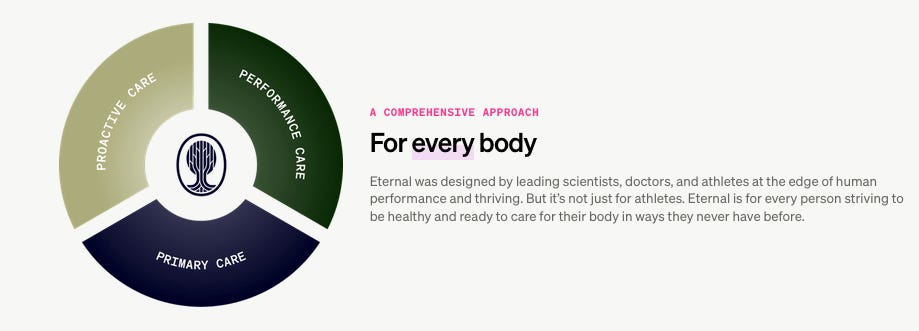
As expectations change, Eternal is one of the first care models built from the ground up around how people actually live; dynamic and context-dependent; rather than the assumptions baked into traditional primary care. It doesn’t try to bolt performance advice or lifestyle guidance onto an old structure. It starts with a simple premise: people need care that adjusts with their training, stress, travel, hormones, and goals throughout the year, not once a year.
Why It Lands
Because Eternal packages this into a coordinated, year-round model, it resonates quickly with people who have been trying to manage these pieces on their own. The fit isn’t about a single feature; it’s about matching the real cadence of their lives.
Across conversations, Eternal stood out for people who described:
Training loads that shift with the season
Hormonal or metabolic changes that need ongoing interpretation
Old injuries with predictable flare-ups
Travel that disrupts routines
Stress patterns that reshape sleep, energy, and recovery
Conflicting advice from multiple providers
These individuals weren’t looking for more appointments or more diagnostics. They wanted a team that could connect the dots, adjust the plan as life changes, and provide consistent guidance over time.
Eternal’s higher-touch tiers work not because they’re “premium,” but because they mirror the complexity of the people drawn to them. For this group, coordination and context matter more than any single test, tool, or protocol.
Taken together, these insights point to something larger than one program: a broad and growing desire for care that matches the rhythm of real life. Eternal is simply one of the first models built to meet that expectation.
Why This Matters
The signal from these conversations isn’t about Eternal’s traction; it’s about a broader behavioral shift happening across a wide range of adults.
Active people may feel the system’s limitations sooner because their lifestyle changes quickly, but they’re not the only ones who are running into the same wall. Parents navigating midlife health changes, professionals juggling stress and sleep, and people managing chronic but stable conditions all described the same underlying frustration: the system treats everyone as interchangeable, even when their lives look nothing alike.
That mismatch is why so many supplementary care models have appeared in recent years; midlife clinics like Midi, metabolic programs, telehealth hormone platforms, online PT, and wearable-driven coaching. Each solves a slice of the problem, but they also widen the fragmentation. People end up with more inputs, more data, and more providers, but no one responsible for connecting the dots.
The next wave of healthcare; the one these conversations point toward; is about integration.
People increasingly want:
Care that understands their patterns
Guidance that makes their data usable
Continuity that follows the arc of their life, not the cadence of annual checkups
A model that blends prevention, context, and primary care
This isn’t a niche trend or a wellness micro-movement. It’s the early formation of a new category of healthcare built around how people actually live, work, and age; not how the system assumes they do.
5 Takeaways
Traditional primary care is showing its limits for many populations. Active adults feel it sooner, but parents, women around midlife, stressed professionals, and people managing chronic lifestyle factors all share the same pain points.
People want care that mirrors their real lives. They’re looking for clinicians who understand their patterns and for systems that integrate (not fragment) their experience.
The missing piece isn’t data; it’s interpretation. Wearables and labs are everywhere. What people want is meaning, guidance, and continuity.
Higher-touch care is gaining traction because complexity is now the norm. Those with fluctuating schedules, recurring issues, and heavy travel aren’t seeking luxury; they’re seeking coordination.
The future of primary care is shifting toward integrated, relationship-driven models. The next decade won’t be defined by new tests, but by systems that make what we already measure usable.
Closing Summary
These conversations revealed something simple and consistent: people aren’t just looking for treatment. They’re looking for care that understands the context of their lives. They want continuity, interpretation, and guidance from a system that can keep up with their stress, their goals, their responsibilities, and the natural changes that come with age and activity.
Traditional primary care wasn’t built for that. Concierge care wasn’t designed for it. Both assume stability and sameness in lives that are anything but.
So people are looking elsewhere. New models that blend prevention, performance, and everyday health into a single, integrated system are beginning to take shape. Eternal is one example of that shift, but the movement is bigger than any one company. What’s emerging is a new category of care that aligns with how people actually live, work, and age; and the demand for it is growing fast.
If this shift resonates with you, or if you’ve felt these gaps in your own healthcare, I’d love to hear your story. These conversations are helping shape where this new category goes next.
Hit reply, leave a comment, or share this with someone who’s been looking for something different in their own healthcare.
Good post Jonathan! The healthcare shift you describe also fits with a broad cultural change (connected with tech) that I call nichification. Everything, including healthcare, is breaking into 100s of niches that better server different groups.
Ooooffffff. It’s hard to read this. I am married to a Geriatric specialist, primary care, Doc. So I guess you gotta take this with a grain of salt. Old people with lots of problems are her specialty and she is one of the best in the country at dealing with it all. Mostly because she is so damn caring. Even with them the answer is not more data. Context sure, but thats never more than a conversation. We are both middle age athletes, me a little more than her. We have some old injuries, we have hectic schedules, we travel a lot. We haven’t seen a primary care doc in years, probably 10, since I last broke my leg. We have never had blood work done “just to get an idea”. We don’t wear wearables. Other than watches when we run. This idea that we need to constantly collect and then have someone to look at a bunch of data when there is nothing wrong is a waste of time and resources. Your being sold an idea that just doesn’t make sense. It’s another hack, more snake oil. Do we need a medicare for all, yes. Is our healthcare system totally wack, yes. We help people figure it out all the time. I watch my wife do things for her patients that go way beyond the norm, and for which she isn’t getting paid for. But for most of us, particularly us athletes type folks it’s pretty simple. Brad Stulberg lays out pretty good adivce. 1. Move your body every day 2. Avoid highly-processed foods 3. Limit (or cut) alcohol 4. Build community 5. No tobacco or nicotine 6. Stay intellectually engaged 7. Sleep when you’re tired Lastly, we see longevity every day, it’s old. It never gets easy. Some smoke and drink and are assholes. Others are the opposite. And then everything in-between. If there is one constant its movement.