
The Trail Running Flywheel
Everyone says the sport is having a moment. Here's the mechanism underneath it, and why I'm betting my career on it.

I bet my career on this sport. I left a steady job to build inside endurance running full time, and there are mornings that decision feels brave and mornings it feels insane. I just spent a week on the ground in Tahoe, across Broken Arrow, TrailCon, and Western States, watching the sport from every angle I could find. I came home more excited than I have been in years. Not because trail is having a moment. Because of why it is having one.
Let me try to explain the mechanism, because the mechanism is the part that makes me think this is durable and not a bubble.
First, the growth is real
I am wary of hype, so let me start with the numbers. Trail running is growing at roughly 8% on a five year average annual basis. Running overall is around 1%. Hiking is around 2%. Trail is expanding several times faster than the activities sitting right next to it. Participation is up roughly 280% since 2008, which is a decade-long climb, not a spike.
Two numbers matter more than the headline growth, though. The sport is not losing the people it gains, and the people who join are racing more often. Acquisition plus retention plus rising frequency is the signature of something that compounds.
It is the difference between a fad and a foundation.
The flywheel
Here is the part I keep thinking about. The growth is not coming from one lever. It is coming from several pieces that build on each other, where one plus one somehow equals three. My favorite equation!
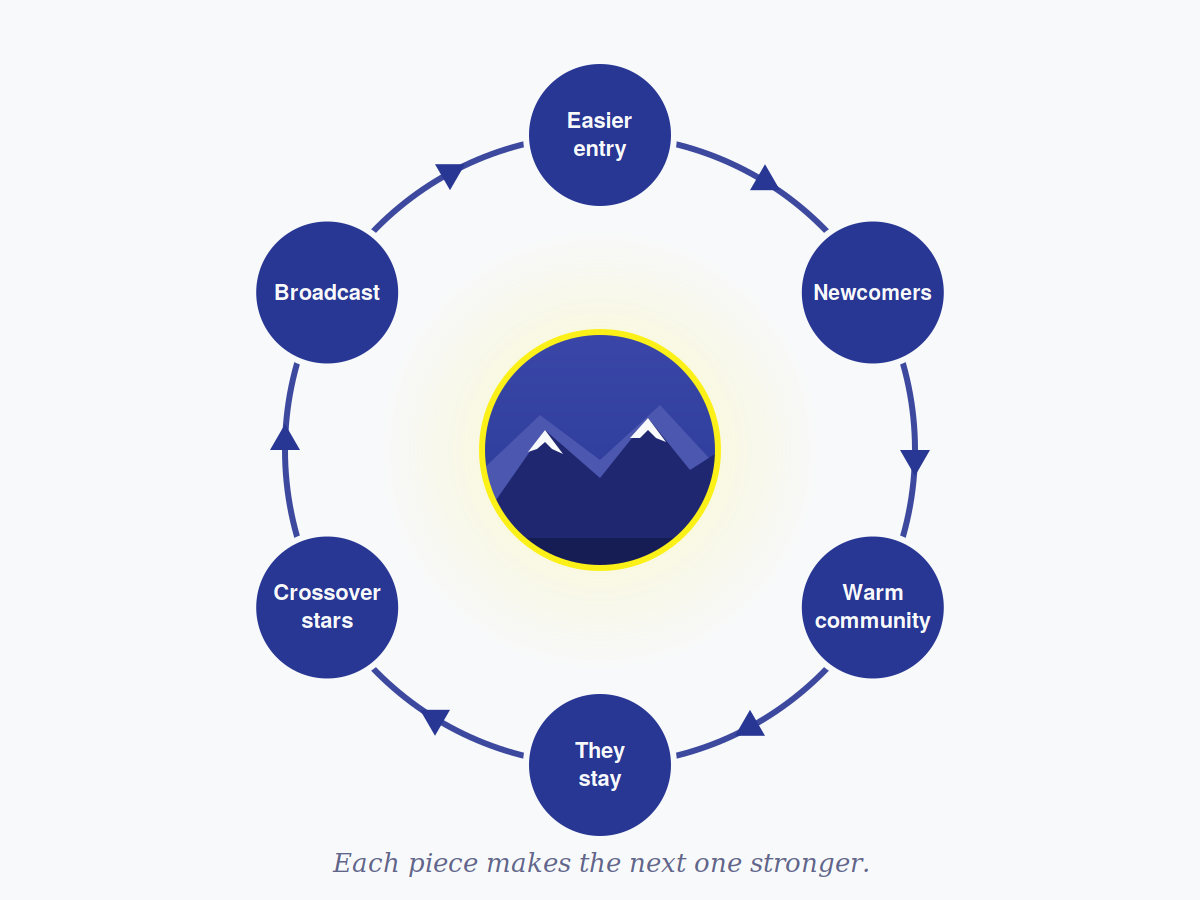
Shorter race distances lowered the barrier to entry. It used to be 50 miles or 100k+ or bust, and that is a terrifying front door. Sub-ultra racing is becoming more and more popular, and offers a distance that does not require you to reorganize your life in order to finish the thing. So newcomers arrive. And when they arrive, they meet a community that is unusually, almost suspiciously warm. I’ve watched runners who had never met cheer each other through the dark. I watched the crowd treat a back of the pack finisher and a podium athlete with the same volume of love. That warmth is not a nice-to-have. It is the retention engine. People stay because of how it feels to be there. Meanwhile, stars from road, track, skiing, and triathlon are wandering over to trail, and they are bringing their audiences with them. And they’re often happily surprised at how welcome they feel, and how much fun they’re having.
The broadcast layer is finally catching up to carry all of it, and it is good now. Really good. A backyard ultra a couple weeks ago pulled around 60K concurrent viewers on a livestream (I noticed about 40K at Western States’ peak!). The production has gotten cinematic: drone lines over the ridges, live aid station cut-ins, commentary that actually knows the athletes and the stakes. The ability to follow racers in or out of aid stations via drone is super cool. Races that used to live in a single canyon on a single day are now something you can watch from your couch three time zones away and feel your own (and DBo’s) heart rate climb. That is new, and it is a bigger deal than most people realize.
So: easier entry brings newcomers, warmth keeps them, crossover stars import new eyes, broadcast turns the sport into something you can watch, and all of that brings in more newcomers. Each piece makes the next one stronger. That is the flywheel, and once you see it spinning you cannot unsee it.
Growing at both ends
The fun, counterintuitive part is that trail is stretching in two directions at once. At one end, the extremes are redefining what the sport even is: last person standing formats, 200 milers, women pushing into the longest and hardest distances in numbers we have never seen. At the other end, the accessible on-ramp keeps widening. The traditional middle is no longer the whole story. The sport is getting more hardcore and more welcoming at the same time, and somehow both are true.
But a flywheel spins around some gaps
Honestly, the part I keep turning over is not the growth. It is the stuff that is not quite there yet.
The sport still mostly tells its stories from the front of the pack, and statistically, the bulk of this community finishes in the middle, and there are a whole lot of underrepresented people in the back of the pack (and other parts). They are the ones who make the finish line loud at midnight, and I would love to see the storytelling catch up to where the people actually are. That gap is sharpest for the people the camera reaches for least. Women's fields are producing the most compelling racing in the sport right now and still get a fraction of the coverage, and runners of color remain underrepresented on the start line, in the sponsorship, who is speaking on panels and making choices at brands, and in whose story gets told at all. Raz at Running Sucks wrote the version of this I keep coming back to, and it is worth your time.
And here is a gap that sits right on top of how much I love the coverage. Even with all of it, we often cannot tell where the racers actually are. The footage looks incredible, but the positional layer, who is leading, by how much, who is closing, drops out for long stretches. Part of that is the terrain. Trackers lag, fail, or go dark the moment the course climbs into the places that make trail trail. Part of it is that the broadcast has not solved how to show it yet. For a sport that is suddenly watchable, the next unlock is making it followable, knowing what you are watching while you watch it. The day I can pull up a race and see the gaps tightening in real time is the day trail coverage goes from thrilling to unmissable.
As I’ve written about, a solve already exists for this. (Disclaimer: my conviction is so strong here that I’m both an investor and advisor in the company that can solve for this)

And here is the one that surprised me most: at the biggest gathering of brands and operators this sport has, I did not hear a single real panel conversation about how AI is changing the way runners find the products they buy. The buying journey increasingly starts with a question typed into a model, not a search bar, and the industry most exposed to that shift has not started talking about it yet. That felt like a miss. It is also exactly the kind of gap that becomes an opportunity for whoever sees it first.
The honest part
Growth has a cost, and I would not be telling the truth if I skipped it. Trailheads are more crowded. The best races are harder to get into. The culture is going mainstream, and some of the rough, improvised magic gets sanded down as the money arrives. The smartest people I sat with all week were asking the same hard question out loud: can this sport grow without losing the soul that made us fall in love with it?
I am optimistic, and here is why. A lot of the people now stewarding trail came from bike, ski, surf, and triathlon. They have already lived through a boom and the bust that followed it. They have seen what happens when a sport gets mined for a quick cycle of attention, and many of them are here, specifically, because they want to help trail avoid that fate. That instinct, growing something on purpose instead of cashing it in; that is the thing that makes me believe.
Why I am still all in
I bet my career on this sport because I believe small, high-trust communities are where the most interesting things happen, and trail is the clearest example of that I have ever found. A week on the ground did not make me nervous about the bet. It made me want to double down.
The growth is exciting. But the gaps are what keep me up at night in the good way, the things not yet built, the people not yet served, the version of this sport that is still coming. It is a good time to be in trail. It is an even better time to help build it the right way.
I will be here doing exactly that.
One more thing, since the AI gap is on my mind. Next week on Long Run Labs I go deep on exactly this with Michael from Centium AI, on how AI is becoming the new front door to brand discovery and what that means for the brands we love.
Jon Levitt is the host of For The Long Run, founder of the Long Run Labs Network (35+ shows, ~1M monthly downloads), and co-founder of The Huddle. This newsletter covers the business of creator partnerships, sponsorship strategy, and what the data actually shows, in addition to a weekly article from that week’s Long Run Labs Podcast.